
AI in injury and claims management
Moving from hype to impact
Artificial intelligence is already finding its way into the way organisations work. In injury and claims management, there is plenty of scope for it to help. Claims teams deal with large volumes of information, repetitive administration and established workflows, often while working under considerable pressure to respond quickly and make sound decisions.
The question worth asking is where AI can make a genuine difference to the outcomes those teams are responsible for.
Saving time has value. Reducing administration has value. Getting information into the hands of a claims manager sooner has value. But none of those things, on their own, tell us whether an injured worker is getting better support, whether intervention is happening earlier, whether a claim is progressing well or whether an organisation is reducing lost time and workplace risk.
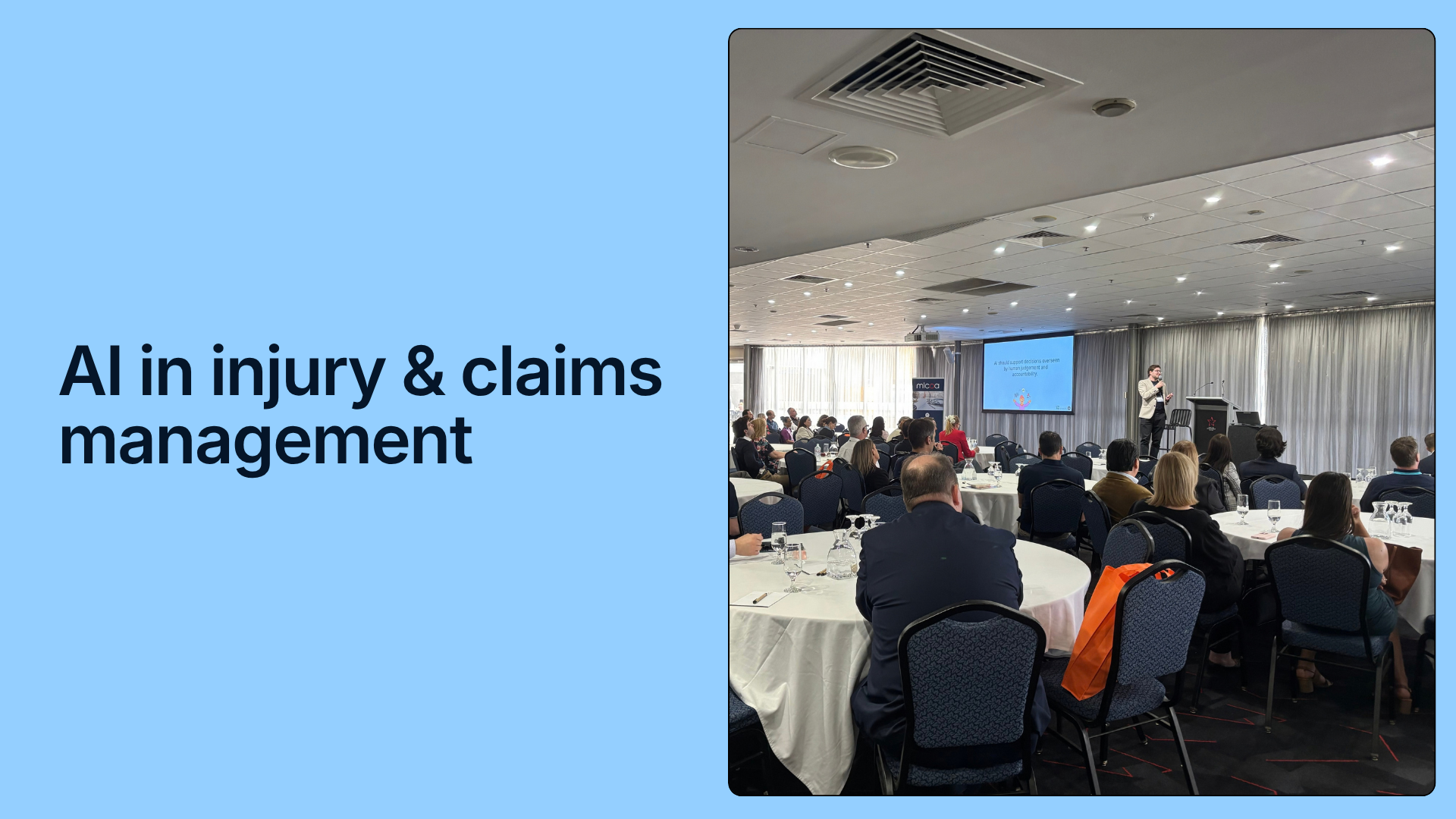
That was the focus of a recent presentation by Michael Stone, Product Manager for Solv at HSI, at SISA in Adelaide. Michael looked at the gap between the current enthusiasm around AI and the evidence we have so far about its impact, with a particular focus on what that means for self-insured organisations.
AI has a role in injury and claims management, but its role needs to be considered carefully, particularly in an industry where decisions can have a direct impact on people’s lives.
Start with what AI is doing
There is a tendency to talk about AI as though it is one thing. In practice, the technology being discussed in 2026 generally falls into a number of different applications, with large language models and computer vision among the most familiar.
Large language models are behind tools such as ChatGPT, Claude and Copilot. They take an input and generate a response based on patterns learned from very large datasets. Computer vision applies similar underlying techniques to images and video, allowing systems to identify or classify information visually.
Understanding how these systems work helps explain one of their limitations. There is no independent fact-checking step built into the basic process that guarantees the answer is correct. The system generates what it predicts is the most likely response based on the information it has been given and the patterns it has learned.
As Michael explained at SISA, “These systems are confident in proportion to the familiarity of the input, not the correctness of the answer.”
That is one reason context matters so much. A system can produce a very convincing response without having a proper understanding of the organisation, the circumstances surrounding a claim or the regulatory requirements that apply to it.
For injury and claims management, where the detail surrounding an individual case can change the appropriate course of action, that limitation needs to be taken seriously.
Where AI fits into the workflow
Michael described three broad ways AI can be incorporated into technology platforms.
The first is AI-enabled technology, where AI sits alongside an existing workflow. A text generation function within a form or a support chatbot would fall into this category.
The second is AI-embedded technology, where AI is incorporated into the workflow itself. Document scanning is a straightforward example. A medical certificate can be uploaded, information can be extracted and the relevant fields prepared for a claims manager to review, rather than someone manually entering every detail.
The third is an AI-first approach, where AI sits behind the workflow and takes on a much greater role in operating it.
There is a temptation to see these stages as a progression, with the most autonomous version being the eventual goal. Michael’s view is more measured, particularly given the nature of the industry.
“Any large scale transformation needs to be a journey, and be implemented through proper change management and reasonable progression.”
For Solv, that means concentrating on applications where AI can become part of the work people are already doing, rather than trying to remove people from processes that depend on professional judgement.
Efficiency is useful, but it is not the whole measure
One of the pressures faced is the expectation that they should be doing something with AI. That pressure can come from executive teams, from technology providers or simply from the concern that competitors are moving faster.
The risk is that AI gets added to a process because it is available, rather than because it solves a problem.
Michael has seen this happen in organisations where AI has been introduced at the quickest and most visible level, without first considering what the business is trying to achieve. In some cases, the technology creates another layer of work rather than removing one.
There is also a tendency to measure the success of AI in terms of productivity alone.
That is a useful measure, but it is only one.
A claims manager who can summarise a file in 30 seconds instead of 30 minutes has saved time. If that time is then available for an earlier conversation with an injured worker, a better review of a return-to-work plan or closer attention to a claim that needs intervention, the value extends beyond the time saved.
If nothing changes beyond the speed of the administrative task, the benefit is much smaller. As Michael put it,
“Speed alone is not transformation.”
For self-insurers, the outcomes worth looking at sit further down the chain. Faster return to work, earlier intervention, reduced lost time, better management of claims and a safer workplace are much more useful measures of whether technology is doing its job.
What one customer example tells us
HSI client, Vigor Marine Group provides a useful example of how this can work in practice.
The organisation had a number of different workflows and forms and was struggling to get a clear view of its reporting structure. Rather than adding AI to those existing processes, the organisation first undertook an audit of its workflows.
AI was then used to help rebuild a centralised reporting workflow, resulting in a reported 66% efficiency uplift in reporting.
The efficiency gain was valuable, but it wasn’t where the work stopped. The organisation continued to focus on the safety outcomes it wanted to achieve and ultimately reached 190 days without a recordable injury at its main worksite.
It would be wrong to suggest that the AI system caused that safety result. Workplace safety outcomes are influenced by many factors, and the case does not establish that kind of causal relationship.
What the example does show is the difference between introducing technology and using technology as part of a broader improvement in the way work is organised.
Three things to consider before introducing AI
There are some fairly practical questions organisations should be asking before putting AI into an injury or claims workflow.
1. Context and accuracy
The quality of an AI output depends heavily on the information available to it. Organisations need to understand what information the system is working from and whether that information is appropriate for the task.
A general-purpose model does not automatically become a specialist in injury management because it has been placed inside an injury management platform. The surrounding data, rules, workflow and human review all influence how useful the result will be.
That is particularly relevant when the output is being used to support a decision about an individual.
2. Privacy and data protection
Claims and injury management involve sensitive personal information, so organisations need to know exactly what happens to the data they provide to an AI system.
Where is it processed? Who can access it? How long is it retained? Is it used to train a model? What controls are in place around access and security?
These questions sit alongside an organisation’s obligations under Australian privacy law and its broader responsibilities when handling personal information.
The regulatory discussion around AI is also developing. Industry and regulators are considering how these technologies should be used in areas where decisions can affect workers, including questions around privacy, oversight and accountability.
For organisations working in injury management, those discussions are worth following closely. Innovation and regulation need to develop alongside one another if new technology is going to be trusted by the people using it.
3. Accountability
The third question is perhaps the hardest to answer.
If an AI system makes a recommendation about an individual claim, who is responsible for the decision that follows?
The regulatory environment is also part of the conversation. ReturnToWorkSA continues to oversee and review the standards and requirements that apply to self-insured employers, including its current consultation on the Code of Conduct for self-insured employers. For organisations introducing new technology into injury and claims management, understanding how those obligations apply should sit alongside the technology decision itself.
For Solv, the principle is clear. AI can help prepare information, identify patterns and reduce administrative work, but responsibility for decisions affecting an injured worker should remain with a person who can exercise judgement and be held accountable for the outcome. As Michael said,
“people should make the decisions that affect people.”
Safety still depends on people
There is understandable concern about what greater automation means for the people currently doing this work.
In injury management, there are good reasons to be cautious about treating human involvement as something technology should eventually remove.
An injured worker is not a collection of claim fields. Return-to-work planning involves circumstances that may not be fully captured in structured data. Early intervention can depend on a conversation, an observation or a piece of context that would be difficult for an automated system to understand.
Claims professionals bring judgement to those situations.
AI can give them better information and reduce some of the work that gets in the way of using that judgement. It can scan documents, identify missing information, surface patterns across large datasets and prepare information for review. Those are useful capabilities when they are applied in the right parts of the process.
They also have the potential to give people more time for the parts of injury management that require human interaction.
That is one reason HSI continues to engage with the wider regulatory and industry discussion around responsible use of AI. The technology will continue to develop, but trust in it will depend partly on whether organisations can demonstrate that privacy, accountability and human oversight have been properly considered.
Where Solv is investing
Our approach within Solv reflects those principles.
One area of focus is workflow automation. There are parts of claims administration that are repetitive and structured, and where AI can reduce manual work without taking responsibility away from the person managing the claim.
We are also looking at how AI can help people work with large amounts of claims data. Identifying trends and patterns across a large portfolio can be difficult when information is spread across individual files. Better analysis can help claims teams see what is happening across their data and decide where further attention may be warranted.
Data validation is another practical application. A document such as a medical certificate can be checked when it is uploaded to identify missing or incomplete information, reducing the need for claims teams to repeatedly follow up for basic details.
These are areas where AI can assist with the work without becoming responsible for the outcome.
There are also areas where we have deliberately chosen not to invest at this stage.
Solv is not currently focused on AI making recommendations or decisions about how an individual’s claim should be managed or how their injury should be treated. We are also not pursuing systems that operate autonomously without a person involved in the process.
That boundary reflects the type of work Solv supports and the consequences that can sit behind an individual claims decision.
What should happen to the time AI gives back?
The technology will continue to improve. Organisations will continue to find new applications for it, and some uses that are inappropriate today may become viable as the technology, evidence and regulatory framework develop.
For now, there is value in being selective.
The strongest use cases are likely to be those where AI removes unnecessary administration, improves the quality or availability of information and gives skilled people more capacity to do their work well.
For a self-insured organisation, that might mean a claims manager has more time for early intervention. It might mean information that would previously have taken hours to assemble is available during a case review. It might mean patterns across claims can be identified earlier and investigated before they become a larger problem.
Those are the outcomes worth working towards.
Michael finished his SISA presentation with a question that is worth taking back to any team considering an AI project.
“If AI gave your team back hours in the day, what would you choose to do with them?”
For Solv, the answer comes back to the people at the centre of injury management. More time to understand what is happening, to intervene when it can make a difference and to support an injured worker through their return to work.
That is a much more useful measure of AI’s value than how quickly the technology can produce an answer.
———————–
ReturnToWorkSA, Consultation: Code of Conduct for self-insured employers, 23 September 2026. View source
Tags:


